![NEH-Logo_Black[1]](https://b2915716.smushcdn.com/2915716/wp-content/uploads/2022/08/NEH-Logo_Black1-300x162.jpg?lossy=1&strip=1&webp=1 "NEH-Logo_Black[1]")
Tour a Contemporary Home in Vermont’s Mad River Valley
February 13, 2026
A home deep in the Mad River Valley showcases a streamlined Scandinavian sensibility while still honoring its rugged surroundings.
Text by David Masello Photography by Ryan Bent


There are always many voices to be heard when a new house is being built, but there was one in particular that was loudest of all for this Vermont residence. That voice definitively told the design team and homeowners what really needed to be done.
“It was the site itself that told us how it had to be developed and the right structure to put on it,” says Elizabeth Herrmann, the Bristol, Vermont–based architect. “It was hard to imagine imposing something on the land since it’s really steep and wooded,” she adds, “but we listened to, and responded to, the site.”
According to Chris Quinn of Red House builders in Colchester, Vermont, these clients differed from others in that while they certainly wanted to take advantage of the Mad River Valley views of the Green Mountains, they also desired a sense of privacy. “It’s a pretty common trend in our area to have clients want the land opened up for big views,” says Quinn. “That was not the intent of these clients. They very specifically wanted the site to feel private, tucked into the woods, with the natural landscape coming up as close to the house as possible.”
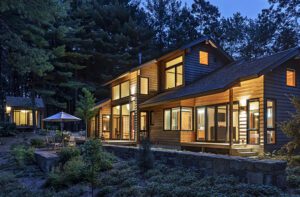
Herrmann’s design for the six-bedroom home manages to embrace thoroughly modern forms while also referencing Vermont vernacular architecture, most notably in the dwelling’s pitched roof. The two-story home is comprised of three volumes, with the main one announced by the steeply pitched metal roof. The other two volumes are discreetly linked by glass-lined connectors.
“The owners were interested in creating something that felt Vermont-y while also referencing regional farmhouses,” Herrmann says. And given the homeowners’ penchant for all things Scandinavian, the architect responded with large windows that capture natural views as if they are paintings. She also designed interior elements that include a long banquette that wraps the corner of the living area, an open-tread staircase whose lower portion culminates in a cascading bench-like effect, and wood-clad vaulted ceilings that absorb sound.
The most conspicuous exterior material is shou sugi ban, an increasingly popular technique that involves charring Japanese cypress wood, texturing it with a wire brush, and then staining it. Herrmann juxtaposed the shou sugi ban with expanses of Scandinavian spruce, lighter in color and defined by a novel groove-like effect. She used the spruce most conspicuously at the entrance. “We wanted a warm, enveloping feel as you enter the house, and the wood accomplished that.”
Landscape architect Keith Wagner referenced the home’s minimal, Scandinavian feel by planting maintenance-free ornamental grasses at the front. He also placed birch trees on the site. “Some of the walls were blank and dark, and the silhouettes of the white bark made for a subtle but strong effect,” he says. “The landscape design was like a haiku poem where you have to say as much as you can in as few words as possible.”
In keeping with that overall poetic sensibility to the house, Herrmann looks upon her design with particular pride. “I always react to how a finished house ultimately feels on its site, how light and space work in, and on, it. Seeing the way the light moves through the house and comes alive is really gratifying.”
Project Team
Architecture and interior design: Elizabeth Herrmann Architecture + Design
Builder: Red House
Landscape design: Wagner Hodgson Landscape Architecture
Share




You must be logged in to post a comment.