![NEH-Logo_Black[1]](https://b2915716.smushcdn.com/2915716/wp-content/uploads/2022/08/NEH-Logo_Black1-300x162.jpg?lossy=1&strip=1&webp=1 "NEH-Logo_Black[1]")
Burr Salvatore Architects Create a Timeless New Canaan Residence
January 9, 2026
In New Canaan, Burr Salvatore Architects imbues a new house with old soul.
Text by Alyssa Bird Photography by Read McKendree/JBSA


When a couple of empty nesters purchased this property in New Canaan, there was a gracious oak tree holding pride of place in the front yard of the existing ranch house. And while plans called for Burr Salvatore Architects to start from scratch and design a new residence, that tree would help set the tone for the project.
“We took pains to preserve the tree, which the driveway loops around,” explains architect Mary Burr. “Sometimes a new build can feel raw, but this tree lends a sense of history and permanence.”
The architects also looked to the past for design inspiration, citing the 1920s and ’30s residential work of architects John Staub of Texas and Paul Williams, who was known for his Hollywood Regency-style homes in Southern California.
“Both architects worked a lot with brick,” says Burr, whose own brick design features a hip roof flanked by two wings with parapets. “It’s a great material because you can play with light and shadow. There’s also an arched entry that’s inspired by Staub’s work, except in this case there’s no horizontal lintel. We gave it a more modern aesthetic by installing glass windows that curve around the door, which took a lot of engineering and one talented millworker.”
Inside the 4,700-square-foot home, all the necessities—including the primary suite—are located on the first floor. In addition to the soaring family room, kitchen, and dining room, there’s also an office, a sunroom, and a screened porch. The second floor houses two guest bedrooms and a playroom for the couple’s grandchildren.
“The clients wanted to downsize to something that’s cozy for two but will accommodate their four children and thirteen grandchildren on holidays,” explains Burr. Despite downsizing, though, “they didn’t want to give up a sense of presence and grandeur.”
To that end, great attention was paid to the interior architecture, ensuring that it is cohesive with the exterior. According to Burr, everything from the custom hardware to the millwork and trim speaks to this early-to mid-twentieth-century language. There are, however, some more contemporary details that keep things from feeling too expected or traditional.
The most prominent is the steel-and-oak bridge that hovers above the family room and provides access to the playroom. “The bridge brings down the scale of the family room while adding some drama at the same time,” says Burr. Such a dramatic design element came with its challenges, though. “It’s the first time we’ve done anything like it,” says Douglas Horn of Hemingway Fine Homes. “It’s hanging from a structural roof rafter and supported into the walls.”
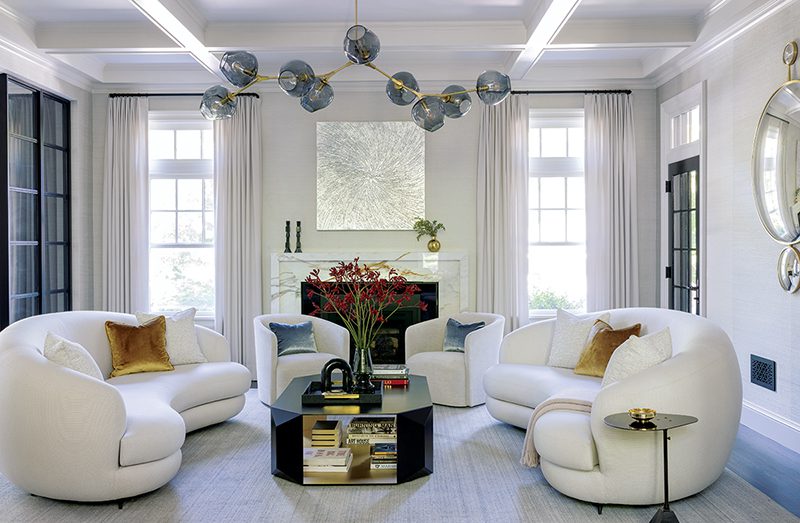
Burr Salvatore also worked with the clients to select streamlined furnishings that are in keeping with the art deco and early- to mid-twentieth-century architectural details. “They wanted contemporary and clean, but still classic,” says Carlos Velez, an interior designer at the firm who conceived a calming neutral palette with touches of soft blue and black for contrast. “The interior architecture features a lot of step details, so we tried to select furnishings that aren’t too square or rigid. We mixed some new art deco–inspired pieces with mid-twentieth-century reproductions.”
The goal, says Burr, “was to create a house that looks like it has been there forever.”
Project Team
Architecture and interior design: Burr Salvatore Architects
Builder: Hemingway Fine Homes
Landscape design: Yost Design
Styling by Katja Greef
Share





You must be logged in to post a comment.